

Large increases in asset values in erratic markets might be advantageous for traders if they can be translated into opportunities. A gap is a place on a chart when there is little to no trading activity in between periods of strong up or down movement in the price of a stock or other financial instrument. As a result, the asset’s chart displays a gap in the typical price pattern. Gap trading is a trading style that can be profitably exploited by a clever trader.
What Is a Gap?
Technical or underlying basic causes are the source of gaps. If a company’s profits are significantly greater than anticipated, its stock may spike the following day. There was a gap created by the stock price opening higher than it closed the previous day.
One relatively recent cause of gap price movement is automated program trading, such as algorithmic trading. If a previous high is broken, the algorithm may indicate a huge buy order. The algorithmic order’s magnitude can cause a price gap to open up, breaking above the previous high and enticing more traders to join the directional movement.
Four categories can be used to classify gaps which are the following:
- Breakaway gaps indicate the start of a new trend when they appear at the conclusion of a pricing pattern.
- Exhaustion gaps indicate a last attempt to reach new highs or lows and appear close to the conclusion of a price trend.
- It is impossible to locate common gaps in a pricing trend. They only show where there has been a price disparity.
- Continuation gaps are another name for continuation gaps. They appear in the midst of a price pattern and indicate a stampede of buyers or sellers who are all in agreement on the direction that the underlying stock is going to take.
When to Fill Gaps
When a gap is said to have been filled, the price has returned to its initial pre-gap level. These fills are rather typical and can be brought on by three things:
- Irrational Exuberance: It’s possible that the initial increase was too optimistic or pessimistic, which would have encouraged a correction.
- Technical Resistance: When a price goes swiftly up or down, it leaves no trace of support or resistance behind.
- Price Pattern: Price patterns are a useful tool for categorizing gaps and predicting when they will be filled. Because they indicate the termination of a pricing trend, exhaustion gaps are usually the most likely to be filled. Because continuation and breakout gaps are meant to validate the existing trend’s direction, they are far less likely to be filled.
When gaps are filled within the same trading day that they exist, it’s known as fading. Imagine a scenario where a corporation reports impressive earnings per share for the current quarter, but it opens lower. It opened much higher than it had closed the previous day. Let’s now assume that as the day goes on, individuals become aware of the cash flow statement’s shortcomings. They begin to sell. Eventually, the price approaches yesterday’s close, closing the gap. During earning season or other periods when irrational exuberance is at its peak, this method is frequently utilized by day traders.
How Can a Gap Be Beneficial?
Price gaps happen suddenly and without warning, making it challenging to position yourself ahead of time. If you’re fortunate enough to long a security and it goes higher, you might make a rapid profit, or vice versa. Entering the market in the direction of the gap as it could trend toward closure is the alternative strategy.
If the gap is durable, the gap price level or zone should offer a chance to profit from the gap’s directional shift at a lower cost. Technical Analysis is often key.
Gap Trading Illustration
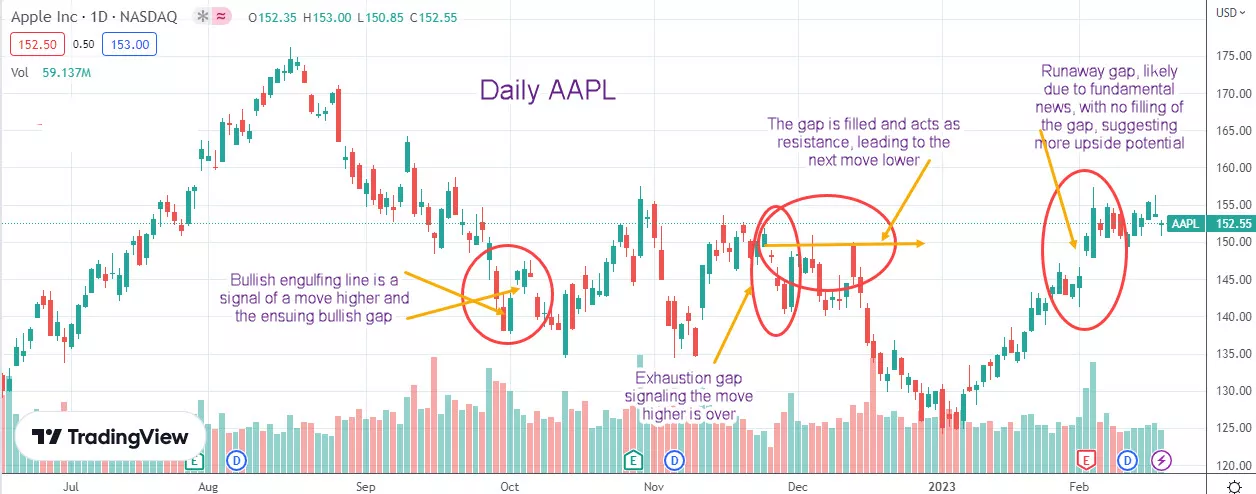
There are several gaps in this Apple Inc. (AAPL) daily chart. This is very typical when the market is closed but news is still flowing in and influencing the market price, as stocks often gap higher or lower than the day’s price activity.
In candlestick analysis, we can see a bullish engulfing line beginning from the left, indicating that the move lower may be reversing. A bullish gap higher follows, which adds more evidence that a low is forming. There is another attempt to break lower, but a huge bullish engulfing line indicates that a low may have already been reached.
A bearish exhaustion gap in the middle suggests that the upward advance is losing momentum and could be about to reverse. Although the gap closes very fast, it still serves as a barrier at the horizontal yellow arrow, indicating that there is still room for decline. Lastly, a robust runaway gap that suggests more upside potential on the right side during a higher reversal is shown.
Gaps represent significant price developments, as you can see. Some are left behind as they guide others into rapid financial success. Gaps, at the very least, are significant aspects of a security’s price behavior and are to be carefully watched for any short-term trading opportunities.